Institute of Contemporary Art Harbor Shore Drive Boston Ma
 | |
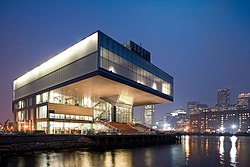 The ICA's electric current edifice in South Boston | |
| Location in Boston | |
| Erstwhile proper name | Boston Museum of Mod Fine art |
|---|---|
| Established | 1936 (1936) |
| Location | 25 Harbor Shore Drive, Boston, MA 02210 |
| Coordinates | 42°21′x″N 71°02′34″W / 42.352843°Due north 71.042857°West / 42.352843; -71.042857 |
| Type | Art museum |
| Accreditation | American Alliance of Museums |
| Director | Jill Medvedow |
| Builder | Diller Scofidio + Renfro |
| Public transit access | Argent Line (SL1 or SL2)  |
| Website | icaboston.org |

The Found of Contemporary Art (ICA) is an art museum and exhibition space located in Boston, Massachusetts, U.s.a.. The museum was founded every bit the Boston Museum of Modern Art in 1936. Since then it has gone through multiple name changes as well as moving its galleries and support spaces over 13 times. Its current home was built in 2006 in the South Boston Seaport District and designed past architects Diller Scofidio + Renfro.[1]
History [edit]

The Institute of Gimmicky Art was founded as the Boston Museum of Modernistic Art in 1936 with offices rented at 114 Country Street with gallery space provided by the Fogg Museum and the Busch–Reisinger Museum at Harvard Academy.[ii] The Museum planned itself as "a renegade offspring of the Museum of Modern Art", and was led by its first president, a 26-yr-old architect named Nathaniel Saltonstall.[3] The first exhibit curated by the new museum was "the first survey show of Paul Gauguin in the Boston Area."[two] Also in this commencement twelvemonth the institution's offset fundraiser was held, the Modern Art Ball, to which many big names in the art world attended including Gala and Salvador Dalí who entered the ball dressed as sharks.[3]
In 1937 the Boston Museum of Modern Art moved to its start self-administered gallery space located at fourteen Newbury Street and instated a 25 cent admission charge. This yr the museum displayed the first survey of dada and surrealist fine art. On exhibit during this show was the at present famous work Object (Le Déjeuner en fourrure) by Méret Oppenheim. This exhibit was followed in 1938 past the museum sponsoring the Ballet Russe de Monte-Carlo's United States premiere. The functioning had prepare pieces and costumes designed by Henri Matisse which was in keeping with the current exhibit, an exam of the relationship between Matisse and Pablo Picasso. The museum as well moved over again, this time to the Boston Fine art Club at 270 Dartmouth Street.[3]
In 1939 the museum officially cut ties with the Museum of Modern Art and inverse its proper noun to the "Institute of Mod Fine art."[iii] After changing its name the museum held a show of German degenerate art, labeled as such by Hitler himself. Artists included in the showroom included Max Beckmann, Ernst Ludwig Kirchner, Emil Nolde, and Paul Klee. The museum hosted a traveling exhibition of Pablo Picasso'due south works in 1940 named "Picasso, Xl Years of His Art", which included Picasso's famous work Guernica. [2] The museum moved for a third time in equally many years in 1940 to 210 Buoy Street and put together Frank Lloyd Wright'southward first museum survey in the The states. The museum stayed on Beacon Street until 1943 when it moved to 138 Newbury Street and assembled the first African American artist survey in New England, including works past Romare Bearden and Jacob Lawrence among others.[3] The museum was as well an of import venue for the Boston Expressionists.[4]
In 1948 the "Constitute of Modern Art" changes its proper name once over again to the "Plant of Contemporary Fine art" (ICA) to "[altitude] itself from the ideological inflections the term 'modern' has accrued in favor of its original meaning: 'that which exists at present.'"[iii] This aforementioned yr the newly renamed ICA exhibits works past Le Corbusier in his first bear witness in a The states museum.[3]
For the next several years the ICA exhibited many touring and self-curated shows, including a 1950 survey of Edvard Munch including his famous work The Scream, a 1952 survey of Wassily Kandinsky including works never seen in the United states, and the kickoff retrospective of Milton Avery in 1953. In 1956 the museum moved once more, this time to the School of the Museum of Fine Arts at 230 The Fenway, where in 1958 information technology organized the first The states museum survey of Roberto Matta. In 1959 the ICA installed artwork on the interior of a Stop & Shop on Memorial Drive in a show titled "Immature Talent in New England." Some claim that the show anticipated the popular art movement and its interest in consumerism.[3]
1960 saw the ICA moving to the Metropolitan Boston Arts Centre, located at 1175 Soldiers Field Road, which was designed by the museums founder, Nathaniel Saltonstall.[2] The newly built, modernist glass-enclosed gallery was 80 feet long and 33 feet wide and was raised 12 anxiety off the basis on steel supports. The ICA just inhabited this infinite until 1963 where information technology moved, this time to 100 Newbury Street. During the 5 years the ICA spent at this location the museum exhibited, among other things, a collection of works by artists representing the United States at the Venice Biennale (John Chamberlain, Jim Dine, Jasper Johns, Morris Louis, Kenneth Noland, Claes Oldenburg, Robert Rauschenberg, and Frank Stella) and in 1965 the museum housed an exhibit on video and electronic art called "Art Turned On" to which Marcel Duchamp attended.[3]
In 1966 the museum organized an Andy Warhol exhibition with roughly 40 works including selections from Campbell'south Soup Cans and portraits of Jackie Kennedy, Marilyn Monroe, Elvis Presley, and Elizabeth Taylor, likewise as the first exhibitions in a museum setting of Warhol'southward films including Eat, Sleep, and Buss. This same year saw Warhol and The Velvet Underground phase a performance of Exploding Plastic Inevitable at the ICA.[3]
1968 saw the ICA render to the Metropolitan Boston Arts Center, at 1175 Soldiers Field Route, for ii years just to movement again in 1970 to the Parkman House at 33 Buoy Street as a temporary home. During these two years the ICA held an exhibit called "Monumental Sculpture for Public Spaces" where big-scale sculptural works past well-known artists, such as Alexander Calder, Donald Judd, Robert Morris, Louise Nevelson, Claes Oldenburg, and Marker di Suvero, were placed in public spaces across the urban center.[iii] Possibly the most notable sculpture from this exhibit was the installation of the original 12 foot tall Cor-10 steel edition of Robert Indiana'due south Beloved on City Hall Plaza[v]
In 1972 the ICA installed the first Douglas Huebler solo show, and information technology briefly moved to 137 Newbury Street. A year later on, in 1973, the ICA found a more permanent habitation at 955 Boylston Street in a onetime police station. The Museum occupied this building for 33 years over which many exhibits and performances were mounted. Highlights from the first decade of the ICA at this location include a 1976 retrospective of Claes Oldenburg in which Oldenberg himself attends, the beginning showing of David Hockney artworks in America in 1977, and in 1980 the museum hosted both the kickoff United states museum exhibition of purely Dada artworks also as a roller disco fundraiser.[iii]
The 1980s saw more exhibitions including the first museum installation of works by Francesco Clemente and Anselm Kiefer in 1982, and in 1984 the ICA joined with WGBH, Boston'due south PBS station, to create and fund the Contemporary Art Goggle box Fund. This fund helped video artists become their works to be broadcast on telly. Later in decade the ICA exhibited works by Allan Sekula in his starting time museum solo testify in 1986, held the New England Premiere of the moving picture True Stories by David Byrne, in 1986, who attended the screening, and in 1989 displayed both the beginning The states survey for Chris Brunt as well as the first dedicated major exhibition of the Situationist International movement.[3]
In 1990 the ICA was the last end for the traveling highly controversial exhibit The Perfect Moment containing the works of Robert Mapplethorpe, as well as displaying the first museum exhibition in the United States of works by Sophie Calle. In 1997 Cildo Meireles received his starting time exhibition in a major Usa museum at the ICA.[3]
The belatedly 1990s saw a dramatic shift at the ICA. A new director, Jill Medvedow, was hired and she embarked upon a new serial called "Vita Brevis" which was a series of commissions of large-scale artworks to exist exhibited in public spaces across Boston. Ane of the get-go works commissioned for this project was a movie projected on the Bunker Hill Monument created by Krzysztof Wodiczko. These works greatly increased the public cognition and image of the museum. Then, in 1999 the ICA won a competition to build a new cultural institution building on Boston'south Fan Pier.[iii]
While plans for the new building on the waterfront were being created and the building itself constructed, the ICA continued to be located at 955 Boylston Street. During these years the ICA exhibited, amongst other things, the start solo exhibition in a museum of works by Cornelia Parker in 2000 and the first United States solo exhibit for Olafur Eliasson in 2001.[three]
In 2006 the ICA moved to its new 65,000 square foot building on Fan Pier containing both galleries and a functioning space. This same year, the museum began to build a permanent collection. Since moving to its new edifice, the ICA has presented world premiers of dance performances by the Mark Morris Dance Group in 2007 and the Bill T. Jones/Arnie Zane Trip the light fantastic toe Company in 2011. Exhibits take included the first major museum surveys of works by Tara Donovan in 2008, Damián Ortega and Shepard Fairey, who was arrested on vandalism charges on his way to an ICA event,[6] in 2009, and Marker Bradford in 2010.[three]
Buildings [edit]
Principal edifice [edit]
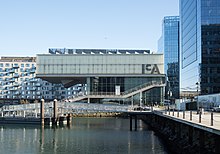
Formerly located on Boylston Street in the Back Bay neighborhood, the ICA moved to a new facility in the Seaport District of South Boston. The museum celebrated the completion of its new building the weekend of Dec 9–x, 2006. The new building coincided with the museum's launch of its first permanent collection.
The new edifice was designed by the architectural business firm Diller Scofidio + Renfro. It is one of that firm'south first structures to be built, and the start to be built in the United States. It is also the offset new art museum to be built in Boston in over a century.
The building is located between the Courthouse and Globe Trade Eye stations on the MBTA Silvery Line.
Critical response [edit]
The edifice's design, which echoes that of nearby waterfront gantry cranes, has been celebrated by many critics for its openness, represented by its outside m staircase, and willingness to comprehend the surrounding harbor.[vii] The ICA was the recipient of the 2007 Harleston Parker Medal, awarded to "the nearly cute piece of architecture" in Boston. It has as well been chosen a "botched box" by architecture critic Philip Nobel, who criticised information technology for having poor circulation, a dull façade facing land, and casting into shadow the harborside promenade that Elizabeth Diller once referred to every bit "Boston's only feasible civic space."[viii]
ICA Watershed [edit]
In 2018, the ICA transformed a condemned 15,000-foursquare-pes edifice in the Boston Harbor Shipyard and Marina in East Boston into the "ICA Watershed".[9] [10] The renovation was designed by Alex Anmahian and Nick Winton.
Admission to the Watershed is free. The ICA offers ferry service from its main edifice to the Watershed, which is open each twelvemonth from leap through fall.
Each year, an exhibit by one creative person fills the infinite. The 2018 exhibit was by Diana Thater, and the 2019 showroom was by John Akomfrah. The planned opening of the 2020 exhibit past Firelei Báez was delayed by the ICA's closure, due to the COVID-19 pandemic. With the museum closed because of the pandemic, the edifice was used as a staging area for delivery of food to East Boston residents.[eleven]
Exhibitions [edit]
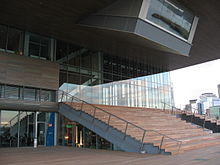
The ICA's exhibition plan has included the Momentum serial, focusing on the piece of work of emerging artists; the Sandra and Gerald Fineberg Art Wall, an annual, site-specific commission in the museum antechamber; the James and Audrey Foster Prize, a biennial exhibition and award for Boston-area artists; and selections from the permanent collection. The West Gallery (known today as Bridgitt and Bruce Evans Family unit and Karen and Brian Conway Galleries), the largest exhibition space, has featured solo and group exhibitions including Super Vision (2006), Philip-Lorca diCorcia (2007), Street Level (2008), Anish Kapoor (2008), Tara Donovan (2008), Shepard Fairey (2009), and Marking Bradford (2011).[12] The almost recent shows include Liz Deschenes (2016), Mark Dion: Misadventures of a 21st-Century Naturalist (2017), William Forsythe: Choreographic Objects (2018-2019).[13]
References [edit]
- ^ "Institute of Contemporary Fine art / Diller Scofidio + Renfro". ArchDaily. 2018-06-28. Retrieved 2019-08-thirty .
- ^ a b c d Smee, Sebastian.A beacon amidst its contemporaries Archived 2011-10-28 at the Wayback Auto. The Boston Globe. September 11, 2011. Accessed Feb 18, 2012. (Annotation: In the printed version of this article, a map with previous ICA venues was included. Some cited information has been retrieved from this map)
- ^ a b c d e f g h i j yard l m n o p q 75. Institute of Contemporary Art / Boston. 2011. edited by Flint, Lucy. Accessed Feb 18, 2012
- ^ Chaet, Bernard (1980). "The Boston Expressionist Schoolhouse: A Painter's Recollections of the Forties". Archives of American Art Journal. The Smithsonian Institution. xx (1): 29. JSTOR 1557495.
- ^ Dannatt, Adrian. Robert Indiana: Hard Edge. New York: Paul Kasmin Gallery, 2008. 14-19.
- ^ Valencia, Milton J.; Shanahan, Marker (7 Feb 2009). "Street artist arrested on style to event at ICA". The Boston Globe . Retrieved 11 Jan 2021.
- ^ Ouroussoff, Nicolai (December 8, 2006). Expansive Vistas Both Inside and Out The New York Times.
- ^ Nobel, Philip (May 18, 2007). "Die Some other Day". Metropolitan Magazine. Archived from the original on 2007-06-26.
- ^ "ICA Watershed". Retrieved 23 April 2020.
- ^ Shea, Andrea (3 July 2018). "A Condemned Building Becomes A 'Watershed': The ICA's New Art Outpost Opens In East Boston". WBUR . Retrieved 23 April 2020.
- ^ Griffin, Grace (25 April 2020). "At ICA Watershed, fresh food for East Boston families". Boston World . Retrieved 29 April 2020.
- ^ "Past Exhibitions". www.icaboston.org . Retrieved September 3, 2018.
- ^ "Past Exhibitions | icaboston.org". www.icaboston.org . Retrieved 2019-02-12 .
External links [edit]
- Institute of Contemporary Art spider web site
- Diller, Scofidio + Renfro website
- Celebrated Boston Incorporated page on the "Christian Herter Middle'" the old Metropolitan Boston Arts Centre
Source: https://en.wikipedia.org/wiki/Institute_of_Contemporary_Art,_Boston

Postar um comentário for "Institute of Contemporary Art Harbor Shore Drive Boston Ma"